
Irish leaders are not short of ambition on AI
What’s missing is enterprise-scale execution.
PwC’s 2026 CEO Survey shows Irish CEOs spend 58% of their time on issues within the next 12 months (vs 47% globally) and only 10% on horizons beyond five years (vs 16% globally).
That gap isn’t just a leadership style issue — it directly explains why AI remains stuck in pilots.
The outcomes are visible:
-
17% of Irish CEOs report increased revenues from AI (vs 30% globally)
-
23% report lower costs (vs 25% globally)
Why this matters disproportionately for Ireland?
For Irish asset managers and investment firms, this matters more than for most industries.
Ireland is not a peripheral player in funds — it is a global centre of gravity:
-
€4.992 trillion in net assets in Irish-domiciled funds (2024)
-
€403 billion in net sales
-
Irish-domiciled ETFs represent ~73% of the European ETF market
When you’re operating at that scale, “AI experimentation” is not a strategy.
Context: the AI ROI problem is real — and Ireland is feeling it early
Globally, CEOs are already showing fatigue with low AI returns.
PwC’s global findings show:
-
56% of CEOs report no cost or revenue benefit from AI so far
-
Only ~12% have achieved the “jackpot” of both revenue uplift and cost reduction
This aligns with what we see across financial services:
firms deploy AI tools, but operating throughput doesn’t change because AI isn’t embedded into core workflows.
Ireland isn’t behind because firms “don’t get AI.”
They’re behind because scaling AI inside regulated, interconnected investment processes is hard — and most firms underestimate the work required.
Our view: AI in Irish asset management will scale when three conditions are met
From experience implementing AI in enterprise investment environments, durable ROI only appears when firms shift from “use cases” to “architecture + workflow compounding.”
1) Scaling AI in asset management takes longer than consumer adoption
Consumer AI spreads in weeks because risk is low and integration is minimal.
Inside asset managers, the requirements are non-negotiable:
-
Permissioning and access controls
-
Audit trails and reproducibility
-
Data lineage across vendors and internal sources
-
Model risk management and lifecycle ownership
-
Operational resilience
-
Regulatory defensibility
This is especially relevant in Ireland. The Central Bank of Ireland has explicitly highlighted AI as transformational and is developing supervisory expectations for regulated AI use.
If firms want to scale AI agents, they must scale the controls around them — or adoption stays limited to low-impact areas.
2) The real payoff comes from accelerating connected workflows
Most early AI deployments focus on isolated productivity wins:
-
Summarizing research
-
Drafting market commentary
-
Extracting data from PDFs
-
Automating basic reporting
Helpful — but they don’t move the P&L.
The real advantage comes when agentic AI spans linked steps in the investment lifecycle:
-
Research → idea generation → portfolio proposal
-
Proposal → guideline checks → compliance sign-off
-
Sign-off → execution → post-trade monitoring
-
Monitoring → client reporting → oversight and review
Speed up one step, you get a gain.
Speed up all dependent steps, and you compress the entire cycle.
That’s how autonomous AI creates structural advantage — by removing friction across the system, not by doing one task well.
3) Trust is a barrier — and a competitive moat if solved
Ireland’s funds ecosystem wins because global institutions trust it.
That trust will extend to AI only if firms can prove:
-
Clear accountability (who owns decisions)
-
Transparent controls and reporting
-
Robust monitoring and escalation
-
Strong governance aligned with EU requirements
The EU AI Act is now live, with phased obligations that will materially affect how AI is governed across European asset management.
Trust isn’t the blocker to scaling AI.
It’s the enabler.
Implications for Irish asset management leaders (next 6–18 months)
1) Stop measuring AI progress by pilots
Pilots build familiarity — not enterprise value.
The real metric:
How many core workflows are running in production with AI augmentation or AI agent automation?
If AI isn’t changing cycle time, control quality, or throughput, it isn’t strategic yet.
2) Prioritize AI agent compliance monitoring for Europe
For Irish firms selling into Europe, governance-heavy workflows are often the fastest unlock.
High-leverage use cases include:
-
Pre-trade guideline checks
-
Mandate restrictions and concentration rules
-
Suitability and product governance documentation
-
Post-trade monitoring and exception triage
-
Audit-ready reporting
These are manual, repetitive, and scale badly with complexity — perfect targets for AI agents.
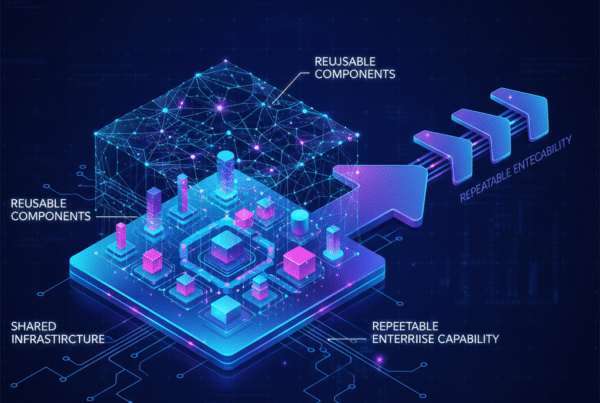
3) Build AI foundations once — then reuse them
Leaders don’t win by buying more tools.
They win by investing in reusable foundations:
-
Unified data access and semantic layers
-
Permissioning and tool access policies
-
Logging, traceability, and evaluation harnesses
-
Model lifecycle controls (monitoring, drift, rollback)
-
Clear operating ownership (IT + investment + risk)
This is what makes AI repeatable across front, middle, and back office — and scalable in regulated Irish environments.
4) Rebalance leadership time — or accept the growth gap
PwC data already signals a leader vs laggard split.
As AI increases operating leverage, the gap will show up in:
-
Faster product launches
-
Lower cost-to-serve
-
Quicker response to market regimes
-
Better client reporting throughput
-
Tighter risk and compliance coverage
Conclusion: Ireland doesn’t have an AI adoption problem
It has an AI scaling problem.
Ireland has the fundamentals:
-
Massive funds footprint
-
Global credibility
-
Deep financial services ecosystem
What will define the next wave of competitiveness is execution discipline:
-
Scaling AI beyond pilots
-
Deploying interconnected AI agents
-
Building governance that enables speed
-
Treating AI as operating-model reinvention, not an overlay
In Irish asset management, the winners won’t be the firms with the best demos.
They’ll be the ones that turn AI into compounding advantage — safely, defensibly, and at enterprise scale.